How Can I Upgrade My Garri Fryer for Larger Batches Without Scorching?
You have decided to upgrade your garri fryer. The question now is what to change, how far to go, and how to make sure the quality holds as you scale up.
You can work through this in order: pin down which upgrade tier fits your situation, pick the right equipment path, size it to your actual production target, and verify the quality before you go to full load.
1. Which Upgrade Tier Fits Your Situation
Your upgrade direction depends on two things: what you are mainly trying to fix, and how far you are from your target.
Diagnose the core problem first.
| What you are dealing with | Primary upgrade direction |
| Quality is unstable — scorching, uneven colour, moisture swings | Upgrade for control: better heating uniformity and agitation |
| Production volume is too low — batch size is too small | Upgrade for capacity: larger vessel or faster cycle time |
| Both quality and volume are problems | Upgrade for both simultaneously; size the equipment to meet both |
Then set your scale target.
| Target output increase | Recommended approach |
| Up to 30% more per batch | Retrofit or add-on: stirring system, feed/discharge upgrade |
| 30–100% more per batch | Replace with a larger automated fryer |
| 100% or more | Add a second fryer or a pre-frying stage |
Jinrui Foodtech (Henan Jinrui) provides customized services based on your current stage, sizing the upgrade to the gap you need to close.
2. Five Equipment Upgrade Paths
Once you know which tier you are in, match it to the right solution.
Path 1: Add or upgrade the stirring system
Best for: Your vessel is adequate; batches scorch because the mash sits still and some zones overheat.
What to do: Install a variable-frequency stirrer, adjustable in speed to match mash viscosity at each stage of frying. A properly driven stirrer keeps the temperature even across the entire pan surface.
Impact: Quality improves significantly. Throughput does not change much on its own — this path is about fixing the quality ceiling.
Path 2: Switch to indirect heating (gas or steam jacket)
Best for: Direct flame gives uneven heat distribution — centre scorches while edges stay underdone.
What to do: Replace the direct-fire setup with a gas or steam jacket. Heat transfers through the vessel wall rather than from a flame underneath, eliminating the hot spot that causes scorching.
Impact: Both quality and batch size improve. With even heat you can push a larger charge safely.
Path 3: Upgrade the feed and discharge system
Best for: Large batches take too long to load, and slow discharge lets the pan cool between batches — both cause uneven heat distribution.
What to do: Add a calibrated screw conveyor for rapid charging. For discharge, specify a fryer with an automatic tilting mechanism — the pan tips forward to empty itself completely and returns to position faster than any manual scrape. This keeps the pan at working temperature between batches and eliminates the cold spot that forms when a batch sits in a stationary pan waiting to be emptied.
Impact: Throughput per shift improves because waiting time drops. Quality improves because every portion of mash spends the same time in the pan and no batch sits in a cooling surface.
Path 4: Replace with a larger automated fryer
Best for: Your current vessel is already running at or near its design limit — stirring and heating upgrades cannot fix the fundamental capacity constraint.
What to do: Specify a fryer matched to your target batch volume, not just a bigger version of what you have. The new unit needs adequate heating power for the larger charge, not just a larger pan. Pair it with the right agitation and temperature control.
Impact: Significant gain in both batch size and quality consistency if sizing is done correctly.
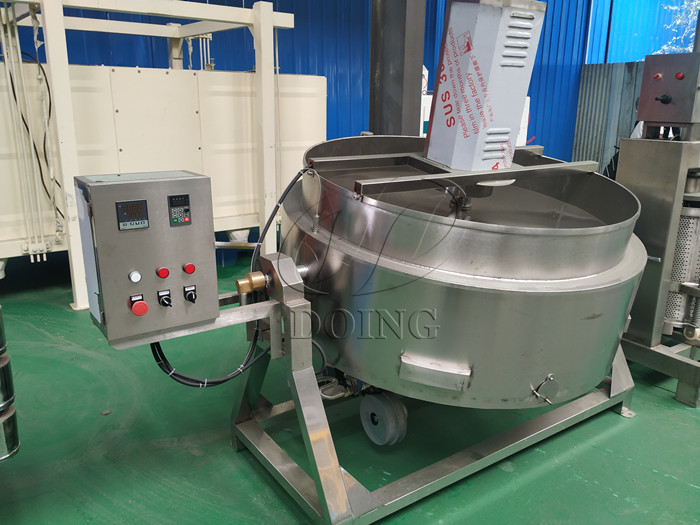 The automatic garri fryer from Jinrui Foodtech
Path 5: Add a pre-frying or staged frying stage
Best for: Single-vessel capacity cannot meet your target no matter how the fryer is spec’d.
What to do: Introduce a pre-frying or two-stage system — the first vessel takes mash to partial dryness, the second completes the frying. This splits the thermal load and avoids overloading any single unit.
Impact: Breaks through the single-vessel ceiling. Quality control depends on managing the handoff between stages.
Jinrui Foodtech supplies automated frying lines with automatic feeding, discharging, and stirring systems matched to your target output.
3. How to Size the Equipment to Your Target
Knowing which path to take is only half the job. Getting the specs right is what actually determines whether the upgrade works.
Size by mash volume, not by finished product weight. When you specify a fryer, use the volume of raw mash you plan to load per batch — not the final dried garri output. A fryer rated for 200 kg of finished garri may only handle 500 kg of mash comfortably.
Heating power must grow with batch size. A common mistake is buying a larger pan with the same heating element. As batch size increases, the heat demand rises faster than the surface area — if the heating power does not keep up, the centre will scorch regardless of stirrer quality.
Temperature control precision matters more at larger batches. At small scale a skilled operator can feel and hear when something is wrong. At larger scale you need a probe reading directly from the mash and a control system that holds the set point within ±15°C or tighter.
Stirrer torque must match mash viscosity. Wet mash near the start of frying behaves very differently from near-dry mash at the end. A stirrer sized for one condition and not the other will load the motor unevenly and eventually fail.
Jinrui Foodtech conducts fryer sizing assessments before purchase to confirm that heating power, stirring capacity, and temperature control are all matched to your production target and quality requirements.
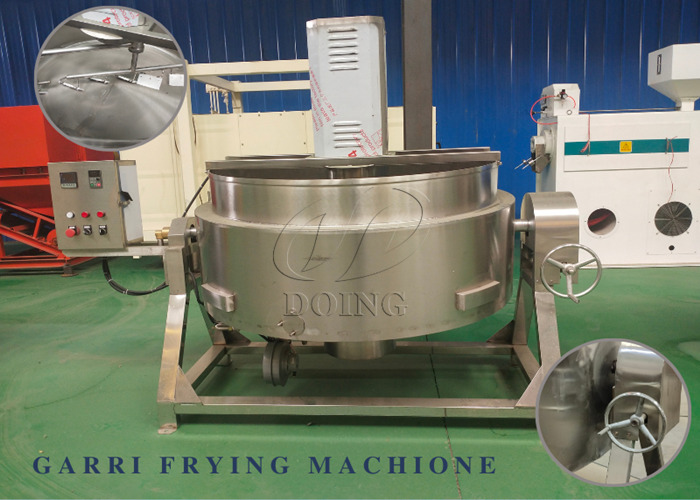 The garri frying machine with stirring system
4. Installation, Commissioning, and Quality Verification
The right equipment still needs to be commissioned correctly. Skipping this step is where most quality regressions happen after an upgrade.
Commissioning checks before first full load:
Confirm temperature probe placement — it must read the mash, not the jacket wall.
Verify stirrer speed curve under load — motor current draw should stay within spec throughout the frying cycle.
Check gas or steam pressure against the design values on the data plate.
Run a verification batch before going to full production. Charge the fryer at 50% of the target batch size. Record exit moisture, colour, and texture. If these match your quality target, run three to five more batches at the same charge level. Only then scale up incrementally.
Write the operating procedure down. The most reliable way to hold quality after an upgrade is to codify it: maximum charge per batch, preheat temperature, stirrer speed by stage, exit moisture target, and drainage time. Make it a reference document for every operator — do not leave it in one person’s memory.
Jinrui Foodtech provides on-site installation supervision and operator retraining as part of its standard commissioning support.
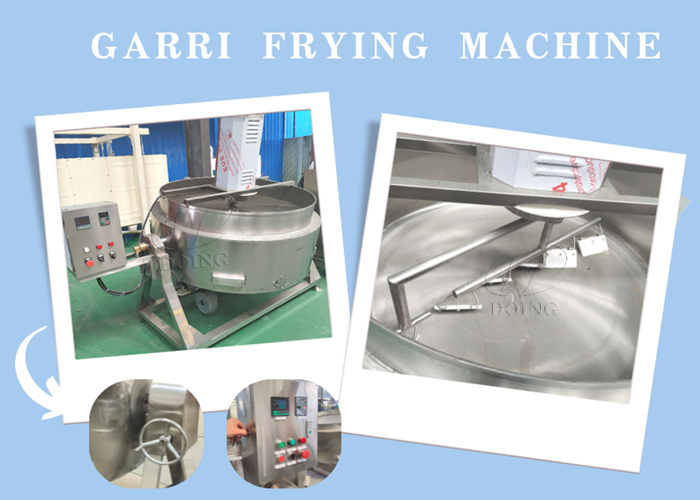 The details of garri roasting machine
5. Frequently Asked Questions
How do I know whether my situation calls for a small, medium, or large upgrade?
Measure three numbers before you decide: your current batch size, how many batches scorch per week, and the maximum fresh cassava you can supply each day. The gap between your supply ceiling and your target batch points to the tier — and if your daily supply cannot feed the larger batch, fix the supply side first; no equipment upgrade will close that gap.
Should I retrofit my existing fryer or replace it entirely?
Retrofit when the vessel itself is sound and the constraint is one or two specific subsystems — the stirrer, the heating method, or the feed/discharge. Replace when the vessel is undersized for your target no matter what you bolt onto it, or when retrofit cost approaches the cost of a properly sized new unit. Get quotes for both before deciding.
What quality targets should my upgraded fryer actually hit?
Run your first five batches at target charge and record: exit moisture (10–12% is the garri standard), colour (even golden, no dark patches), and texture (dry to the touch, no soft centres). Keep a log. If any batch falls outside these three marks, hold at that charge level and troubleshoot before increasing.
How long after commissioning does it take to get stable output?
Expect two to three weeks of adjustment once commissioning is complete. Operators need to build feel for the new equipment — different charge weights, different preheat times, different signals that the batch is ready to come out. Running 20–30 batches at target charge during this period is the most reliable way to lock in stable quality.
What ongoing maintenance does an upgraded fryer need?
Three areas matter most. Check the stirrer seal and bearing every 50 batches — this is where most unplanned stoppages start. Clean the temperature probe tip weekly; a coated probe gives false readings and causes over-frying. Inspect the jacket or heating surface monthly for scale or carbon buildup, which reduces heat transfer efficiency and pushes the centre toward scorching.
6. Get a Fryer Upgrade Assessment
Upgrading without a clear picture of what you need to change costs money and time. Send Jinrui Foodtech your current fryer specifications, target batch size, and quality targets, and get a matched upgrade recommendation built around your production stage.


Comments
Post a Comment
Hi,write down you message,and let's talk according the difference.