How Should I Upgrade From Manual to Mechanized Cassava Flour Processing?
Upgrading from manual to mechanized cassava flour processing is not one decision — it is a sequence of decisions: which stage to automate first, what size to buy, when to add the next machine, and when to connect everything into a full line. Getting the sequence right means you spend less, avoid creating new bottlenecks, and end up with equipment that fits your operation at every stage.
Here is the path that works for most small and growing plants: find your biggest bottleneck, buy the machine that fixes it, confirm your site can handle it, add the next machine only when your output outgrows the first, and move to a connected line when your market demands it.
1. Which stage should you automate first?
Before you look at any equipment, find the stage that costs you the most in time and labor right now. Do not guess — track it.
How to find your bottleneck: Spend one production day timing each stage and counting the people at each one. Write it down. The stage with the most hours and the most workers is almost always your first automation target.
Across most cassava flour operations, these three stages rank highest:
Rasping or crushing. Physically demanding, takes the longest of any single step, and how fine the pulp comes out affects every downstream stage — pressing, drying, and final flour quality.
Dewatering or pressing. Hand-pressing is slow and hard work. The moisture coming out of pressing directly controls how efficiently your drying runs.
Drying. Sun drying ties up your workforce for a full day and produces inconsistent moisture batch to batch. One rainy afternoon can ruin an entire batch.
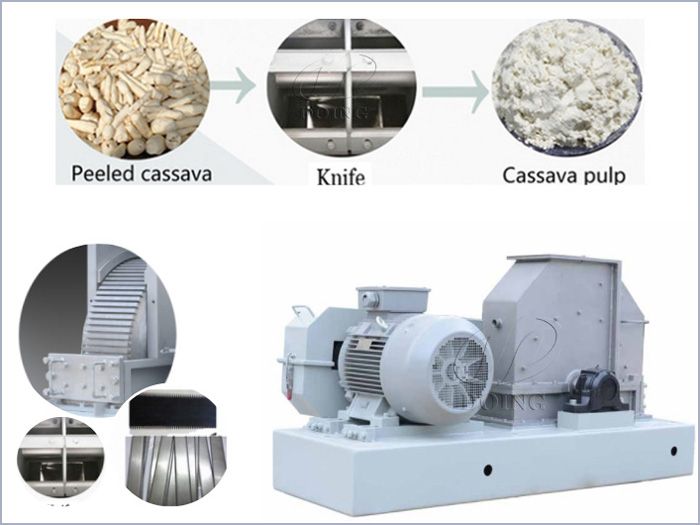 Cassava flour processing equipment upgrade solution
2. What size and type of equipment do you need?
Size the machine to what you process today — not to what you plan to process in two years.
| If your situation is… | Add this first | Because it fixes… |
| Manual operation, limited budget | Single rasping machine | Your biggest labor and time bottleneck |
| Rasping covered; pressing or drying is next | Mechanical press or small dryer | Faster pressing; weather-independent drying |
| Several tons per day, semi-automatic within reach | Rasping + pressing + drying as a connected set | Cuts the manual handling between stages |
| Higher volume, targeting export buyers | Full or semi-automatic line | Moisture control, consistency, throughput |
One sizing mistake to avoid: Do not buy a machine with significantly more capacity than your current throughput. A 10-ton-per-day rasper in a plant running 3 to 4 tons of roots daily wastes electricity and capital. Size up when your machine is regularly at or near its limit.
Jinrui Foodtech (Henan Jinrui) supplies cassava flour processing equipment at a range of capacities, so you can match the machine to your current output without overbuying.
3. What site preparation do you need before machines arrive?
Machines need four things: power, water, space, and trained people. Skipping this step is the most common reason new equipment sits idle after installation.
Power. Cassava processing machines run on three-phase electricity. A single rasping machine needs about 7.5–15 kW; adding a mechanical press brings the total to about 10–22 kW; adding a small flash or rotary dryer requires another 15–30 kW. A small semi-automatic line with rasping, pressing, and drying together draws about 40–60 kW. Many rural sites only have single-phase supply, which must be upgraded before the machines can run. Utility upgrades can take weeks or even months, so sort this out before the equipment arrives.
Water. Washing cassava roots takes several cubic meters of clean water per hour. Confirm your source can supply this continuously, and plan drainage — wash water carries soil and starch and needs a settling pit or separate drain away from the processing area.
Layout. Arrange machines in a straight line matching the process sequence: washing and peeling first, then rasping, then pressing, then drying, then milling and sieving at the end. The goal is to move grated pulp and pressed pulp as little as possible by hand. A compact layout where each machine feeds the next cuts labor and prevents pulp from cooling or oxidizing between stages.
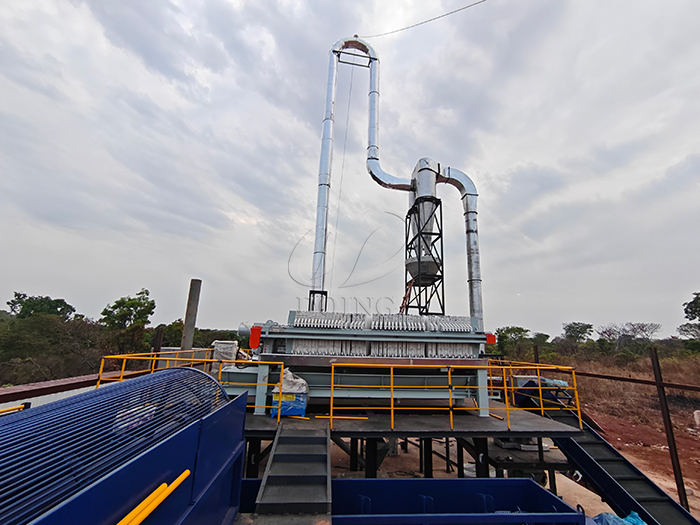 Cassava flour production line layout
Operators. Workers with manual cassava experience can run mechanical equipment, but they need new skills: how to check blade sharpness on a rasper, how to set and read press pressure, how to monitor dryer temperature. Plan for at least a week of hands-on training under supervision before full production begins.
4. What does the staged upgrade path look like?
Most small and growing plants go through three stages. Each stage is triggered by a production signal — not a calendar date.
Stage 1 — Add your first machine. Pick the stage that is your biggest bottleneck. For most plants this is a rasping machine; for some it is a mechanical press. Everything else stays manual. The goal at this stage is to prove the ROI on your worst bottleneck before you invest further.
Stage 2 — Add the second and third machine. Add the next machine only when the first one is running reliably and its output is outpacing what your manual downstream stages can handle. The usual sequence: press after rasper, dryer after press, mill after dryer. The trigger is simple — your current machine is near capacity most days.
Stage 3 — Connect the machines. Once you have three or more machines running separately, the next move is connecting them into a semi-automatic line where pulp moves from one machine to the next with minimal manual handling. This is the step that changes the operation most — not because of a single new machine, but because removing manual handling between stages cuts labor hours dramatically and removes the quality variation that comes from pulp sitting between steps.
Jinrui Foodtech designs its equipment to be compatible with each other — adding a connecting element later does not mean replacing what you already have. Each machine you already own becomes part of the larger line.
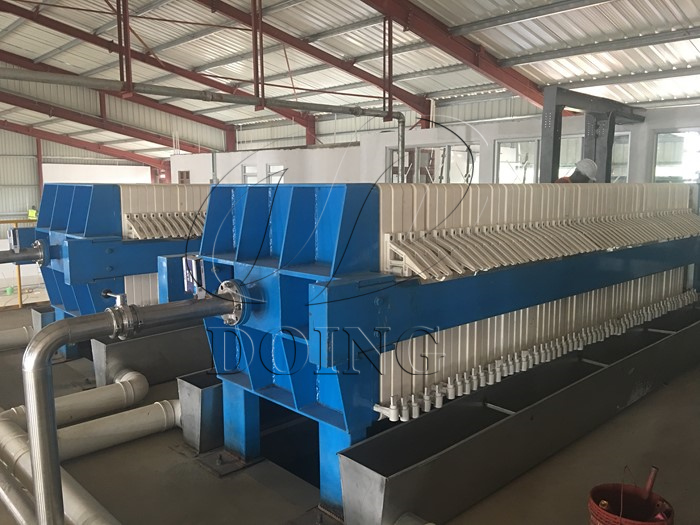 Automatic cassava flour dewatering machine
5. When is it time for a full or semi-automatic line?
There is a point where adding one more standalone machine stops making sense. The signal is not a single number — it is a combination of factors.
Start thinking about a full line when:
You are running three or more machines and manual handling between them is eating up the labor savings the machines created.
Your buyers are asking for volume and consistency you cannot supply with separate standalone machines.
Your revenue consistently covers operating costs plus the machine payments — the upgrade can pay for itself without cash flow strain.
What a full or semi-automatic cassava flour processing line changes is control. Moisture content, granule size, and microbial quality are managed automatically, not by operator feel. That is what larger buyers — wholesale distributors, food manufacturers, export markets — actually need.
The trade-off is real: higher upfront cost, everything connected so one problem affects the whole line, and a need for reliable power and a real maintenance plan. But the consistency, the labor reduction, and the access to higher-tier buyers are what come next.
Before you commit, confirm four things: your power supply handles the full line load, you have the floor space, you have or can hire people who can run automated equipment, and your cash flow survives the investment without cutting into working capital.
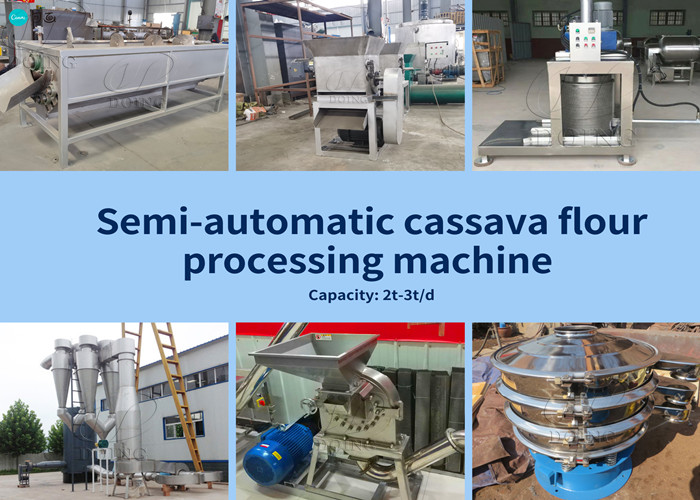 Semi-automatic cassava flour processing machine
6. Frequently Asked Questions
What should I check before buying my first machine so it can be added to a line later?
Check four things before you order: the machine should follow a standard build, not a one-off frame or motor size; the inlet and outlet dimensions should fit a conveyor or chute; it should be available in a range of capacities, which shows it belongs to a compatible design; and spare parts should still be supported a few years from now. Get all four confirmed in writing.
How long does installation and commissioning take?
A single machine usually takes a few days to mount, wire, and test-run. A connected line or full setup takes longer, because each stage has to be calibrated in sequence and the line is not ready until test batches run steadily. If your power or water connection still needs work when the equipment arrives, add that time on top.
How often does equipment need maintenance, and what wears out fastest?
Daily: check rasping blade sharpness, pressing plate alignment, and belt tension. Weekly: grease bearings and tighten fasteners. Rasping blades wear fastest — resharpen or replace every few weeks, or as soon as the pulp turns coarse. Pressing plates, screen meshes, dryer belts, and heating elements are checked monthly.
Can I run new mechanical equipment alongside my current manual process during the switchover?
Yes — and running them in parallel is the safest approach. Run one batch through the new machine and one batch manually at the same time. Compare the output. Once the mechanically processed batch meets your quality standard, gradually reduce the manual batches and retire the manual process.
Can one operator run a whole line, or do I need a person at every machine?
Standalone machines start out with one operator each, since you still load and unload by hand. Once machines are connected into a semi-automatic line, one operator can supervise several stages at once — material moves between machines without being carried. Most small lines still keep one person at the feeding end and one at the packing end, with the middle stages running unattended.
7. Upgrade your cassava flour line when it makes sense for your situation
The right upgrade path starts with finding your real bottleneck, adding the machine that fixes it, confirming your site can support it, and adding the next machine only when your output outgrows the first. Each step pays for itself before the next one begins.
If you know your current daily output, which stage you suspect is your biggest bottleneck, and your approximate first-machine budget, send those details to Jinrui Foodtech and get a configuration recommendation built for where you are now.


Comments
Post a Comment
Hi,write down you message,and let's talk according the difference.